The Class is an important year in a student's life and this subject requires dedication, hard work, and practice. It's a subject where you can score well if you are well-versed with the concepts, remember the important formulas and solving methods, and have done an ample amount of practice. Worry not! Home Revise is here to make your journey even easier. It's essential for students to have the right study material and notes to prepare for their board examinations, and through Home Revise, you can cover all the fundamental topics in the subject and the complete syllabus.
The eighth chapter in the NCERT Class 10 Science Syllabus focuses on the Reproduction process. The chapter covers the asexual reproduction in unicellular organisms before delving into the topic of sexual reproduction and its significance. You will also get to learn about Pollination and Fertilisation in Plants. The chapter also extensively covers Sexual Reproduction in Humans, including the Male and Female Reproductive Systems, the concept of Puberty, the Fertilisation Process, and Contraception.
The topics in Chapter 8 include:
With NCERT Solutions for Class 10 Science, you can study the entire chapter with ease and learn how to accurately draw the necessary diagrams and label them.
Chapter 8 – How do Organisms Reproduce Excersice
Q.1 What is the importance of DNA copying in reproduction?
Ans: DNA copying is essential to produce organisms which are similar to their parents. As copying of DNA brings some variations each time, the surviving cells are similar to parent cell but subtly different from each other. This tendency for variation during reproduction brings variations among the individuals of the same species.
Q.2 Why is variation beneficial to the species but not necessarily for the individual?
Ans: Niches are well-defined places in the ecosystem where population of organisms lives in. If population of reproducing organisms is suited to a particular niche and if that niche is drastically altered or destroyed, because of uncontrollable reasons like temperature changes, water level changes etc, the population can be wiped out. However, if some variations are present in a few individuals in these populations, there will be chances for their survival. The surviving individual can further reproduce and develop a population as per the changed niche. In this way, variation is beneficial to the species but not necessarily for the individual.
Q.3 How does binary fission differ from multiple fission?
Ans:
Binary Fission :
i. Nucleus divides into two daughter nuclei.
ii. Constriction is formed in the cell after nuclear division.
iii. Only two daughter cells are produced.
iv. It takes place in favorable conditions.
Multiple fission:
i. Nucleus divides into many daughter nuclei.
ii. Division of cytoplasm occurs very late thus many cells are produced simultaneously.
iii. Many new daughter cells are produced.
iv. It takes place in adverse conditions
Q.4 How will an organism be benefited if it reproduces through spores?
Ans: Spores have a hard outer covering that is able to withstand adverse conditions of high temperature, shortage of water and food.So, if an organism reproduces through spore formation it can easily withstand these adverse conditions.
Q.5 Can you think of reasons, why more complex organisms cannot give rise to new individuals through regeneration?
Ans: Higher complex organisms cannot give rise to new individuals through regeneration because:
i. Higher organisms have very complex body designs i.e. they show the following hierarchy of organization cell-tissue-organ-organ system.
ii. Higher organisms do not have special calls which help in regeneration of lost part.
Q.6 Why is vegetative propagation practiced for growing some types of plants?
Ans: Vegetative propagation is used to grow some plants such as banana, orange, rose etc because these plants have lost the capacity to produce viable seeds.
Q.7 Why is DNA copying an essential part of the process of reproduction?
Ans: DNA copying is essential to produce organisms which are similar to their parents. As copying of DNA brings some variations each time, the surviving cells are similar to parent cell but subtly different from each other. This tendency for variation during reproduction brings variations among the individuals of the same species
Q.8 How is process of pollination different from fertilization?
Ans:
Pollination:
i. It is the process of transfer of pollen grains from anther to stigma.
ii. Through this process, pollen grains carrying male nucleus reaches at the tip of stigma (part of female reproductive system).
Fertilization:
i. It is the process of fusion of male and female nucleus.
ii. Through this process, diploid zygote is formed which develops into a seed.
Q.9 What is the role of seminal vesicles and prostate gland?
Ans: Secretions of seminal vesicle and prostate gland provides nutrition and motility to the sperms. This secretion also helps in the transport of sperms.
Q.10 What are the changes seen in girls at the time of puberty.
Ans:
Following changes are seen in girls at the time of puberty:
i. Increase in the breast size of the girls.
ii. Growth of hair under the arm-pits and pubic hair starts.
iii. Menstruation cycle commences.
iv. Skin becomes oily.
Q.11 How does the embryo get nourishment inside the mother's body?
Ans: Embryo in mother's body get nutrition through a nutritive connection called placenta.
Q.12 If a woman is using a copper-T, will it help in protecting her from sexually transmitted diseases?
Ans: No, because copper-T will not prevent contact with body fluids. Thus, it will not protect her from sexually transmitted diseases.
Q.13 Asexual reproduction takes place through budding in:
(a) amoeba
(b) yeastB
(c) plasmodium
(d) leishmania
Ans:
(b) yeast
Q.14 Which of the following is not a part of the female reproductive system in human beings?
(a) ovary
(b) uterus
(c ) vas deferens
(d) fallopian tube
Ans: (c ) vas deferens
Q.15 The anther contains:
(a) sepals
(b) ovules
(c ) carpel
(d) pollen grains
Ans: (d) pollen grains
Q.16 What are the advantages of sexual reproduction over asexual reproduction?
Ans:
Following are the advantages of sexual reproduction over asexual reproduction:
i. In sexual reproduction, cells with different genetic material fuse together. Thus, it leads to mixing of different characters and emergence of new characters.
ii. Accumulation of variations leads to formation of new species.
iii. Sexual reproduction has speeded up the process of evolution.
Q.17 What are the functions performed by the testis in human beings?
Ans: Testes are the primary reproductive organs in males. The function of testes is to make male sex cells called sperms and also to make male sex hormone called testosterone.
Q.18 Why does menstruation occur?
Ans: The removal of the inner, thick and soft lining of the uterus along with its blood vessels as well as blood in the form of vaginal bleeding is called menstruation. In humans, after a girl attains puberty, ovaries start producing mature ovum every month and also uterus lining gets thickened to receive zygote. When the ovum does not get fertilized and uterus does not receive any zygote then menstruation occurs to excrete lining of uterus and degenerating ovum.
Q.19 Draw a labelled diagram of the longitudinal section of a flower.
Ans:
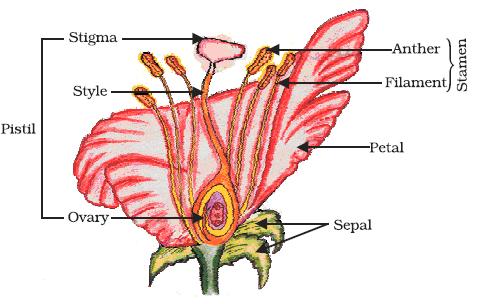
Q.20 What are the different methods of contraception?
Ans:The different methods of controlling child birth are:
(i) Hormonal methods: Various kinds of pills containing hormones which prevent the release of egg from the ovary, without interfering with other phases of menstrual cycle, are taken orally.
(ii) Barrier method: These are the physical barriers which prevent the sperms meeting the egg. Physical devices such as condoms, diaphragms and cervical caps are used.
(iii) Intrauterine Devices: Commonly called as I.U.Ds, they are the devices made of plastics and come in different shapes. The most commonly used is copper-'T'. These devices are placed inside the uterine cavity and prevents the implantation in the uterus.
(iv) Surgical methods: The surgical methods are safe and permanent. Vasectomy occurs in males and tubectomy occurs in females.
a. Vasectomy - In this procedure, a small piece of vas deferens is cut and removed and the two ends of the cut vas deferens are tied.
b. Tubectomy - In this procedure, fallopian tubes are cut and tied which prevents the passage of eggs.
Q.21 How are the modes of reproduction different in unicellular and multicellular organisms?
Ans: Unicellular organisms contain only one cell so they reproduce by asexual reproduction.
Example: budding, binary and multiple-fission are some of the asexual methods. Multicellular organisms which have complex body design and have specialised reproductive organs. So, they reproduce by sexual means. Example - Humans, animals, plants reproduce sexually.
Q.22 How does reproduction help in providing stability to populations of species?
Ans: Reproduction is the process through which an organism produces new organism of its own kind. It is necessary because in a population, organisms die due to old age or disease thus, it keeps the number of organisms in a population constant and provides stability to a population.
Q.23 What could be the reasons for adopting contraceptive methods?
Ans: Following are some reasons for adopting contraceptive methods:
(i) For population control.
(ii) To prevent spread of STDs (sexually transmitted diseases).